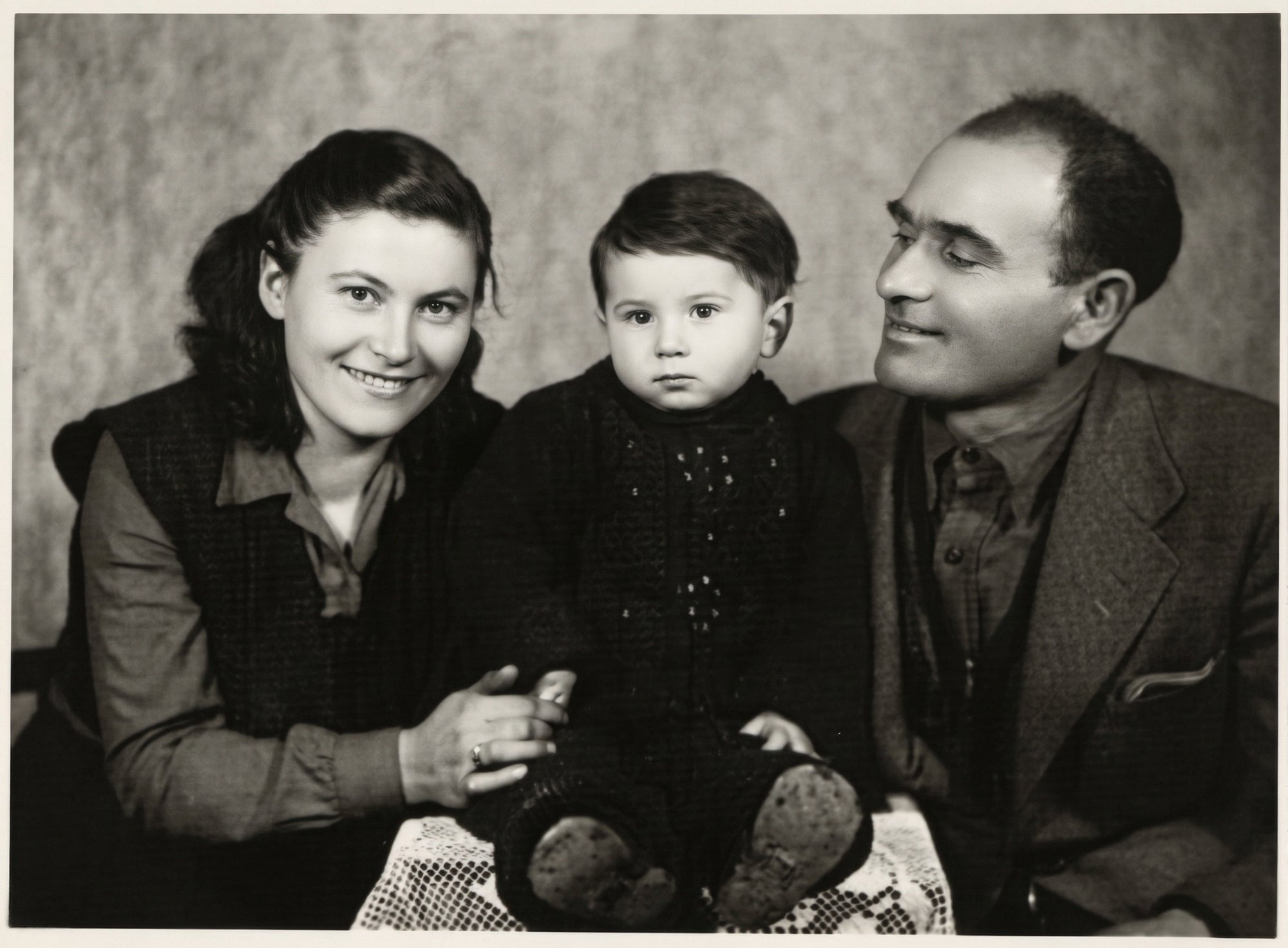
My Childhood in Post World War II Hungary and Our Escape to Freedom
The Rosenfeld Family
The struggle to survive the Holocaust, Hungarian anti-semitism, and Communist oppression — told through one family's journey from a small village in northeastern Hungary to freedom in America.
Dedicated to the memory of Dave (Dezső) Rosenfeld and Sara (Sarolta) Rosenfeld and the six million who perished.
In 1939, Hungary had about 500,000 Jews, roughly 4–5% of the population. Twenty-five percent lived in Budapest, but Jewish communities had been rooted in Hungarian towns and villages since the 700s. This story begins in two of those small villages in the northeast — Szamossályi and Csenger — near the Romanian border.
Before World War II, the population of Szamossályi was about 1,000 people, of whom there were 25 Jewish families — a total of 113 Jews. After the war, only three Jews returned to the town: Dezső Rosenfeld (my father), Gross Abraham, and his nephew Gross Miklos. A number of other survivors emigrated to the USA, Canada, Australia, and other countries.
113 → 3
Jewish residents of Szamossályi before & after World War II
Chapter II
Family Roots — Before the War
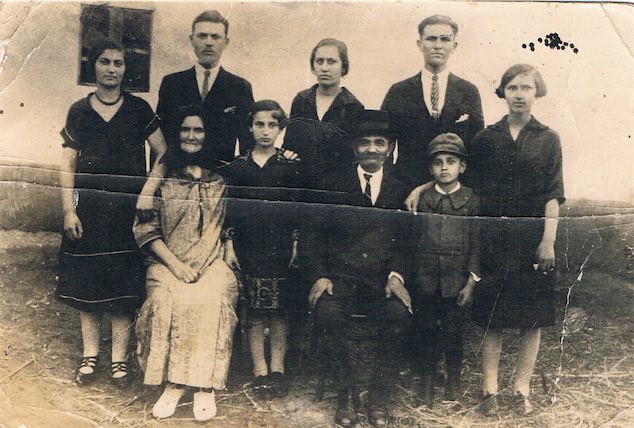
My family had a long history in Hungary, dating back to the 1700s, with family members proudly serving in the army during World War I. The Rosenfeld and Herskovits families had deep roots in this region — they were merchants, farmers, and devout members of the Jewish community.
The Rosenfeld family, Szamossályi, 1920s.
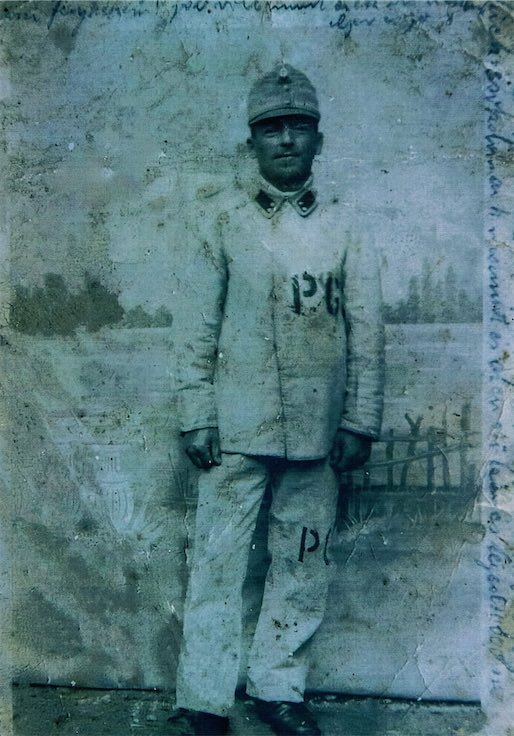
Grandpa Herskovits — a prisoner of war in France during World War I. The letters "PG" on his uniform stand for Prisonnier de Guerre.
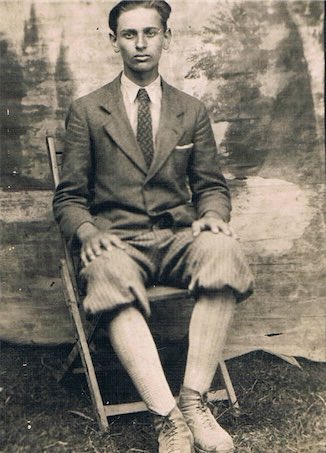
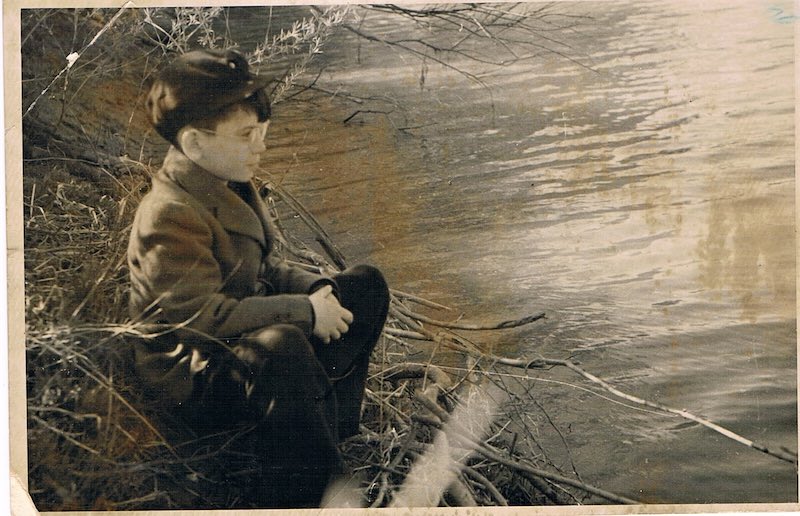
My namesake, Uncle Pál Rosenfeld. He was a self-taught musician who made his own violin and taught himself to play. He was also an avid fisherman on the Szamos River, which ran through our back yard. I too have musical abilities and love fishing — some of his genes found their place in me. He was killed in Auschwitz.
Aunt Serena Rosenfeld Seltzer — Dad's sister who left for the USA in the 1930s. She migrated to America and married in the Bronx before the war. Her decision to leave saved her life.
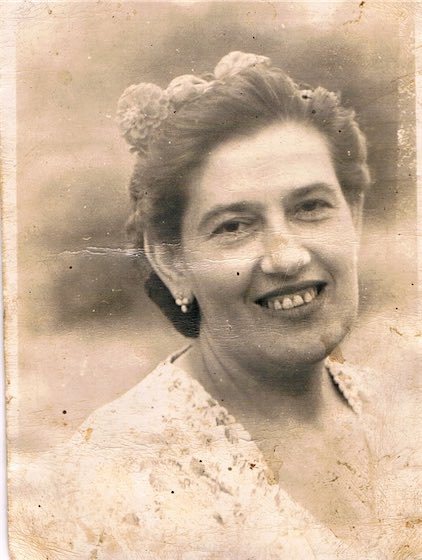
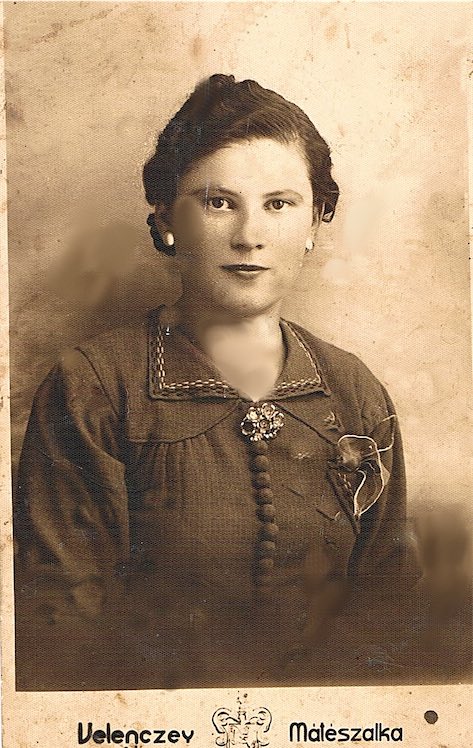
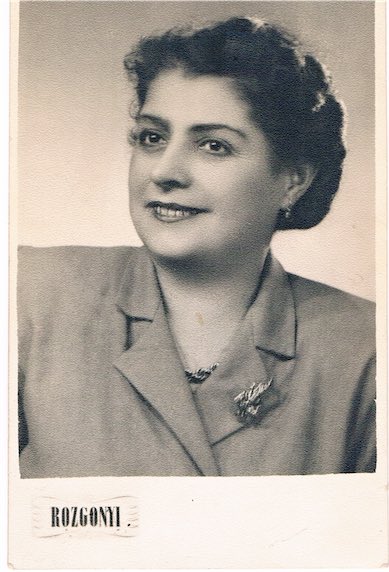
Sarolta Herskovits — my mother. She was a very beautiful young woman.
✦ ✦ ✦
The Herskovits Women and Jewish Life in Csenger
Csenger, the home of the Herskovits family, was six miles from Szamossályi, my father's town. My mom would later take me there sitting on the bar of her bicycle. Csenger had a large Jewish population by 1820 and they built a large synagogue.
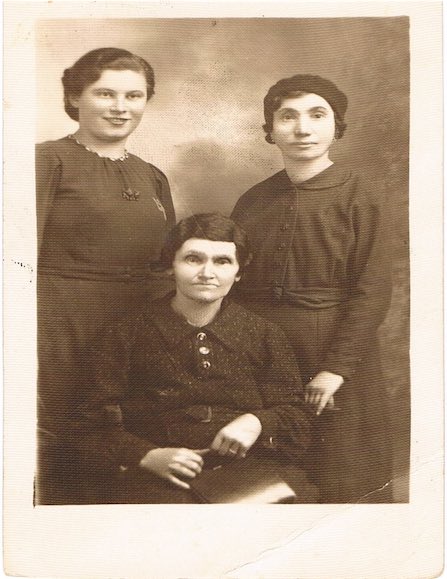
From left to right: Mom, Great Grandma, and Grandmother, 1939.
The Herskovits women of Csenger. From left to right: Joli, Grandma, and Sarolta my mother, circa 1938.
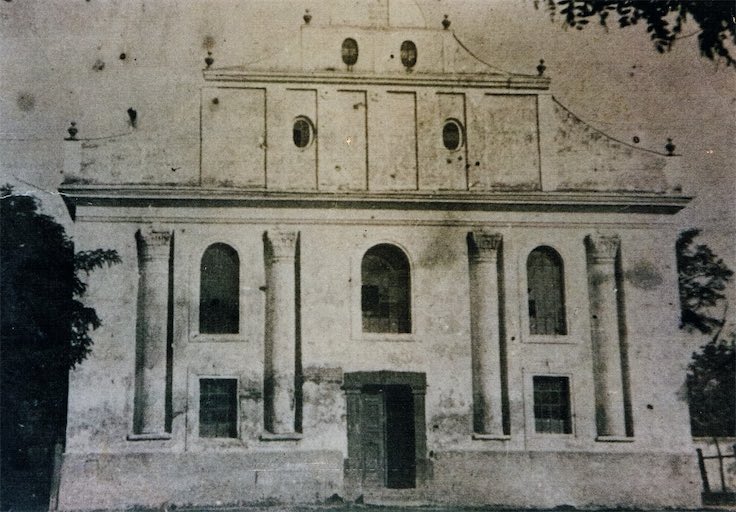
The Csenger Synagogue. In 1903, the community contributed 10,000 gold coins to build an addition that housed the elementary school. The sign on the adjacent building read "Israelite Elementary School." The Jewish population of Csenger in 1912 was 800. The synagogue was torn down in 1956.
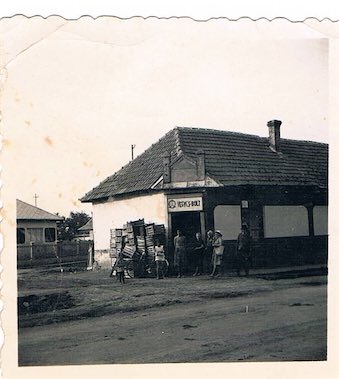
The Herskovits family grocery store and home in Csenger. On my last trip back, I found out the store also served as a bar and liquor store — known to the townsfolk as "Moses's Bar."
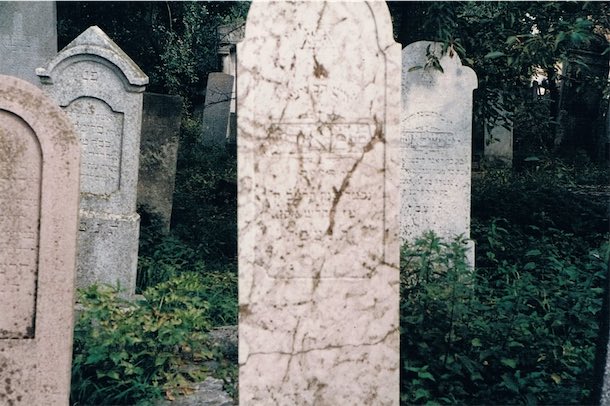
The Jewish Cemetery in Csenger — monuments dating back to the 1700s. The community was well established.
My father's first marriage, to Ilonka. He rarely spoke about his first family, but their loss scarred him deeply. Ilonka and their two daughters and son were all killed at Auschwitz. Their loss turned him into a very angry man.
Chapter III
Munkaszolgálat — Forced Labor
Hungary entered World War II on the side of Germany. Jewish men were not allowed to serve in the regular army. Instead, they were forced into what was called Munkaszolgálat, which roughly translates as "Labor Service." It was essentially forced slave labor. Most men died and did not return.
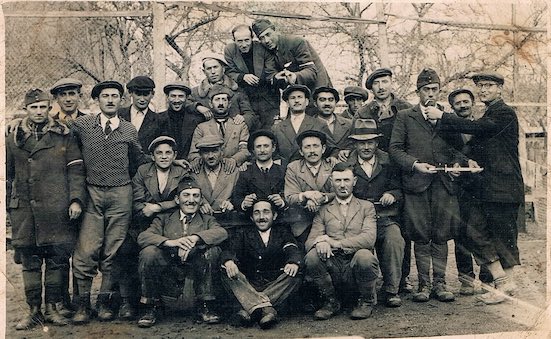
Rosenfeld Sandor and fellow forced laborers in Raho, Hungary (now Ukraine), November 26, 1940. One of these men is my uncle Sandor. He mailed this postcard to his wife in Szamossályi. The men are smiling and playing with their bayonets and rifles — this was taken before Hungary became deeply involved in the war.
My father was in a forced labor battalion of 500–800 Jewish Hungarian men. They were forced by the Germans to build roads, dig mines, and do quarry work in Ukraine and Belarus. They were often forced at gunpoint to clear land mines by walking through the fields. Food was meager, medical care was non-existent. The brutal winters took their toll. If you couldn't perform the work, you were shot to death on the spot.
Of all the men in his battalion, my father and one other laborer survived.
Most of my father's forced labor took place near the cities of Minsk and Pinsk, at that time part of Ukraine. The book The Invisible Bridge by Julie Orringer tells a story so close to my father's that you could change the name of the main character to Dezső Rosenfeld. I was fortunate to meet the author at a book signing and showed her some of my father's mementos — she was very appreciative, having never actually seen some of the items.
✦ ✦ ✦
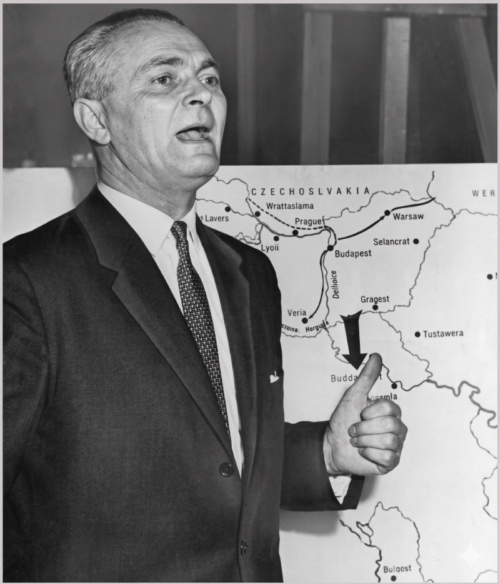
Professor Béla Király
Professor Béla Király, Hungarian general and military historian.
While attending Brooklyn College in the late 1960s, I took many Military History courses. There I had an amazing professor — Béla Király. He was a Hungarian General who actually led the military uprising against the Russians in 1956. Like the Rosenfelds, he escaped Hungary in the aftermath of the revolution to save his life. All the politicians and military men who supported the uprising were taken to Russia and executed by hanging.
He died in Budapest in 2009 at age 98. His New York Times obituary revealed an amazing fact: during WWII, he was the commander in charge of a group of Jewish forced laborers. When the Germans moved in 1944, they demanded he strip his men of their Army uniforms and treat them as slave laborers. He refused the German orders and protected his men. Most of the men under his command survived. He is recognized as a Righteous Gentile at Yad Vashem in Israel.
Chapter IV
Auschwitz
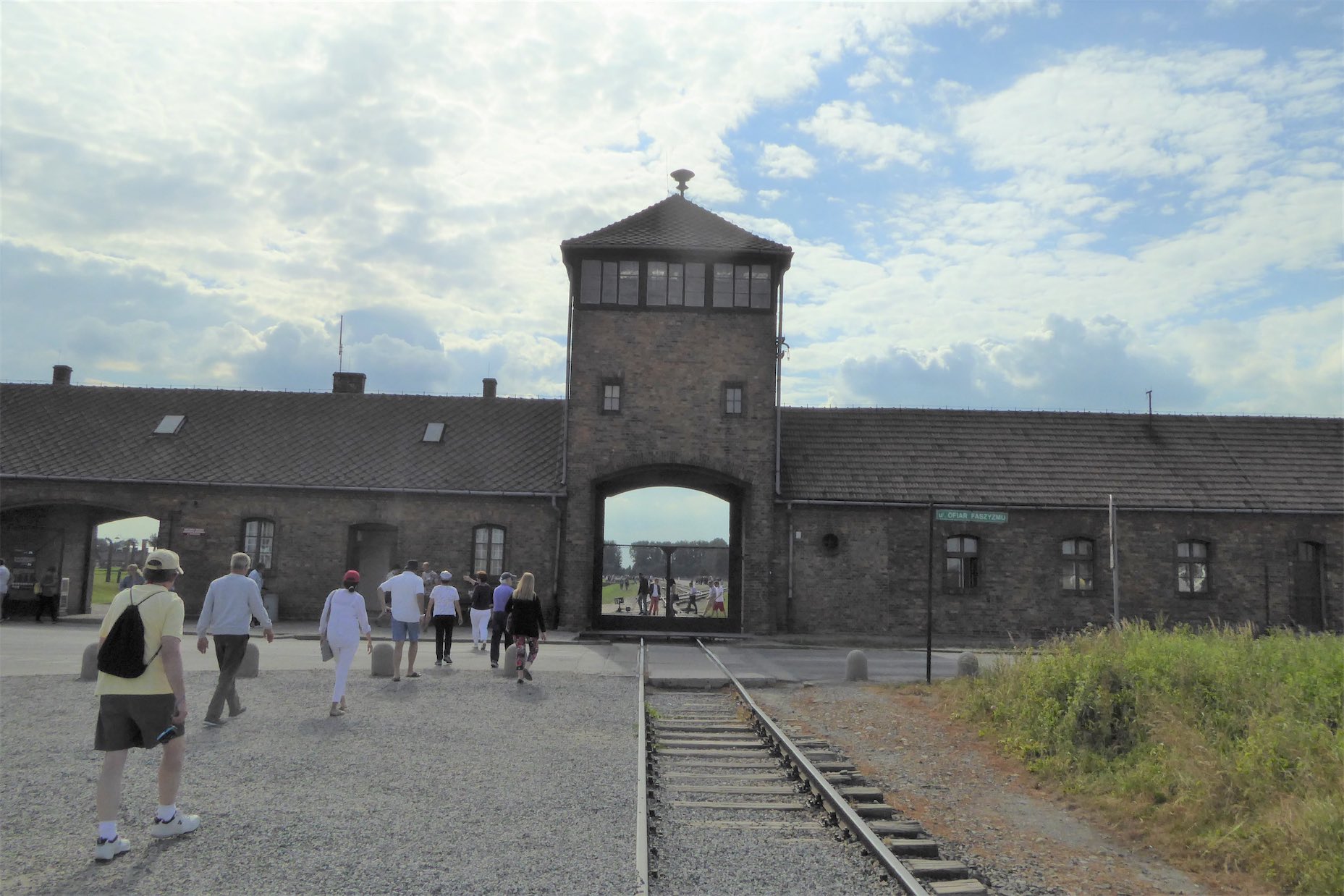
The gate of Auschwitz-Birkenau.
In 1944, all the occupants of the Mateszalka Ghetto, where my family was being held, were deported to Auschwitz-Birkenau.
When my mom was forced out of the cattle car, she saw a stretcher with a covered body on it. Only the shoes were exposed. My mother recognized the shoes immediately. Her mother — my grandmother — had died in the cattle car taking her to Auschwitz.
The Hungarian Jews were then led to the selection line where Dr. Josef Mengele was waiting.
When my mother and her sister approached Mengele, he sent my mother to the right — she was 22 years old. Her sister Joli was only 15; the Doctor sent her to the left, separating them. At this point my mother became hysterical, yelling that she wanted her sister to be with her and that she did not want to be separated. Her effort was successful: Mengele pointed to my aunt and told her to join my mother. Only later did my mother know that she had just saved her sister's life.
Life in Birkenau
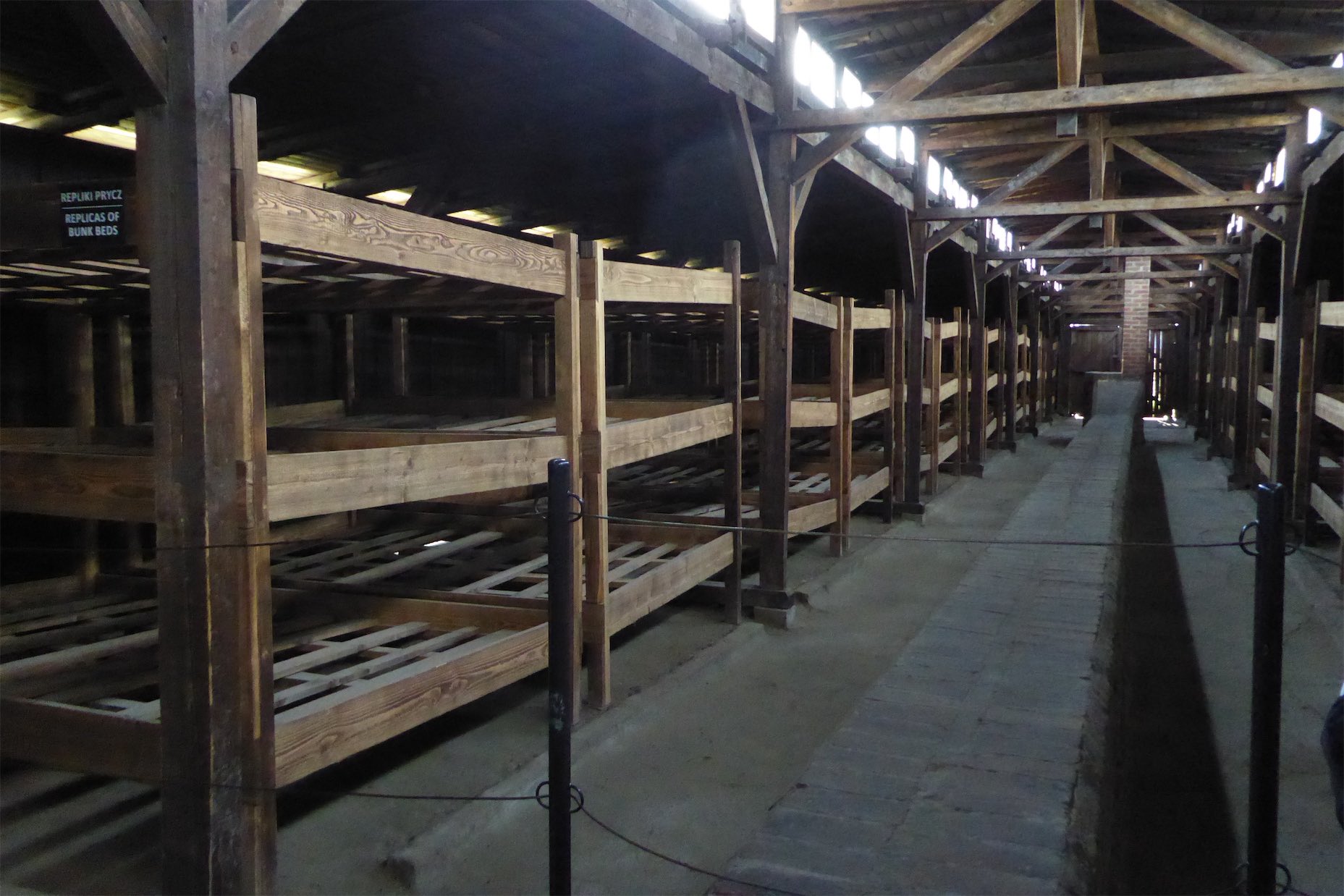
They survived on bread, soup, and scraps of food including stolen potato peels. My mother worked in a factory making cots for the German Army. Many died of typhus in the crowded barracks, each of which held 36 wooden bunk beds.
The crowded, primitive barracks of Birkenau. Replicas of the wooden bunk beds where prisoners slept.
Fortunately, the Hungarians were the last European Jews to be deported to Auschwitz, arriving in May 1944. Auschwitz was liberated one year later.
My mom did not realize she had been in Birkenau until 50 years later. In 1994, she went back to Auschwitz with her sister and an Israeli delegation commemorating the 50th anniversary of the liberation. She regretted making the trip — she had many nightmares afterward.
565,000
Hungarian Jews killed between 1941 and 1945. Today about 100,000 Jews remain in Hungary; of those, roughly 10,000 are observant.
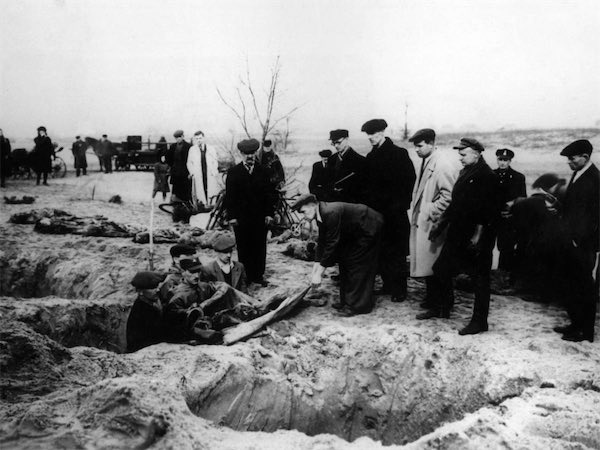
After liberation, the true horrors were exposed. Across Eastern Europe, mass graves were uncovered as the world confronted the scale of what had taken place.
Chapter V
After the War
After liberation, many surviving Hungarian Jews opted to move to Palestine or other countries around the world. Many lived in DP camps in Germany until they were able to immigrate to their new homes. A number of my cousins and friends were born in German DP camps while their families waited to leave for the USA.
My parents opted to return to their homes in Hungary to see who was still alive. After returning, they found that most family members had been killed.
According to the townspeople, my father was a remarkably resilient man. After he returned to town, he appraised the situation, moved back into his house, and within two weeks he had the farm up and running again — buying livestock and planting the crops for the season.
✦ ✦ ✦
A Very Unusual Proposal
My uncle Pal had dated my mother prior to the war, and my father had known her. After returning, they got together. My father made a very unusual proposal.
"You were good enough for my brother — you're good enough for me."
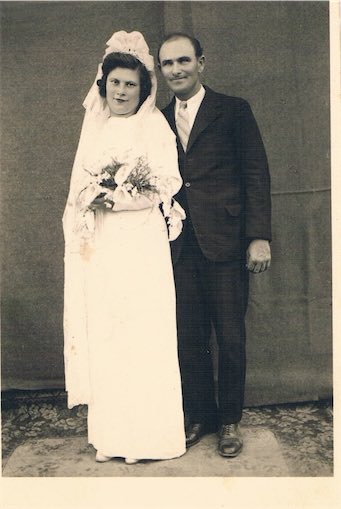
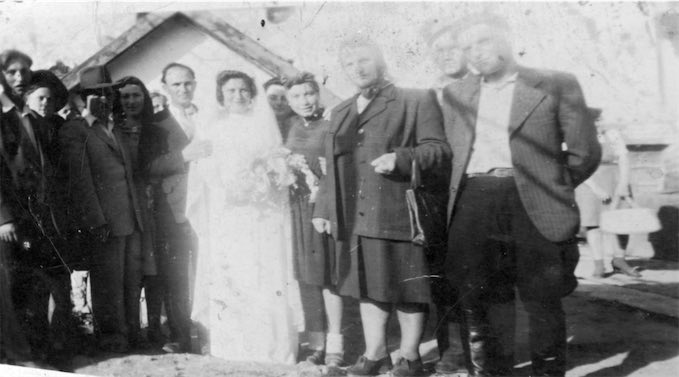
She accepted, and two weeks later they were married. My mother cooked all the food for the celebration.
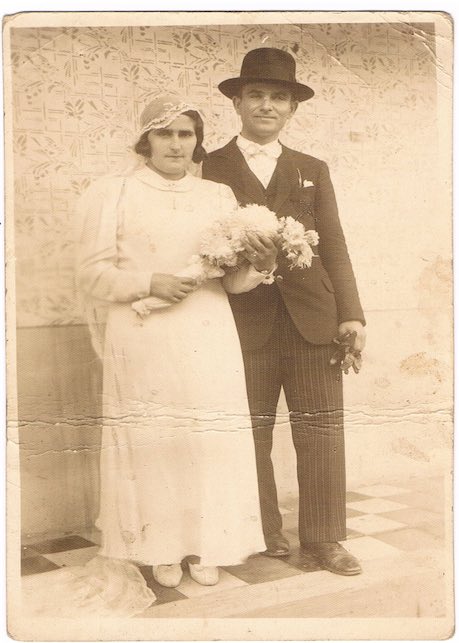
Wedding Day, May 1946.
The wedding reception.
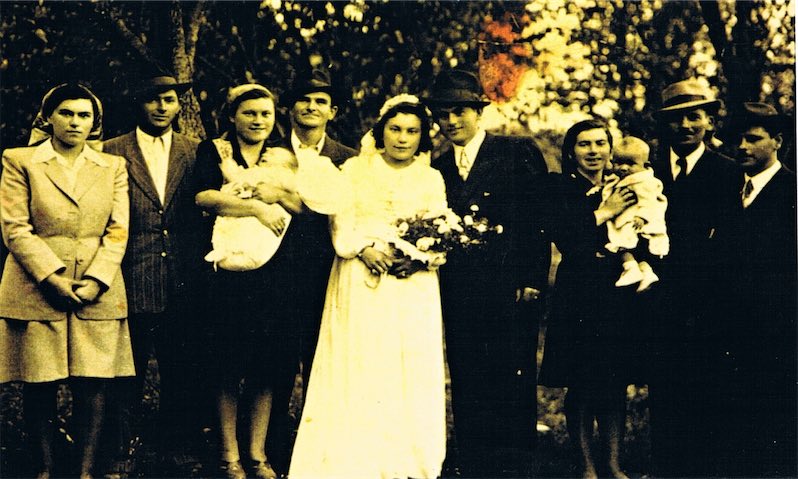
Aunt Joli's wedding, 1947 — the first wedding I attended. Standing on the right is my mother's uncle Jeno Helmeczi. He and his wife had 8 children. Their survival story is the exception to the rule: the train taking them to Auschwitz was bombed, and the entire family of 10 escaped their Nazi captors and all survived.
Chapter VI
Life in Szamossályi
I lived in Szamossályi for the first nine years of my life. I was in the third grade when we escaped Hungary. It was a small town with one general store, a barber shop, a liquor bar, a community center, and one church. Our home was lit with a kerosene lamp. We had one of the few radios in town, powered by a large battery. Some of my father's friends would come to us at night and listen to the radio broadcasts as the men sat around peeling Jonathan apples fresh from our orchard.
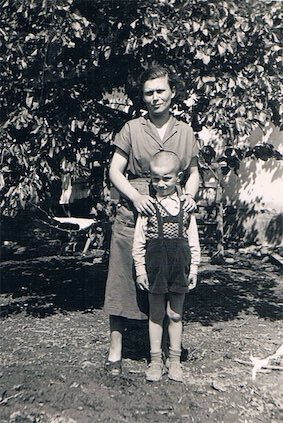
My mother and me in the apple orchard, Szamossályi.
The River Szamos, a tributary of the Tisza and Danube, was in our back yard. We grew all our own vegetables. Dad had a barn with several cows. Each evening Mom would milk the cows and stuff the geese with corn to fatten them up. I drank fresh milk every day. Mom used that milk for making homemade hand-churned butter, sour cream, yogurt, and buttermilk. On Friday mornings my parents would bake challah and the bread to be eaten during the week.
My father made a good living by town standards from his apple orchard. Rather than sell the apples to a middleman, he would arrange for a truck to carry them to Budapest and sell them at retail at the farmer's market.
I spent my summers playing soccer with my friend Aladar and my dog Bundas. Often my father would ask me to keep an eye on the cows as they grazed near the river. My parents worked hard and long. Farming was dangerous — they nearly died when both were poisoned by a nicotine pesticide they were using on the apple trees. They were taken to a nearby city, Debrecen, where they were given antidotes. I was about five years old at the time; it was a very frightening time for me.
Our nearest synagogue was four miles away, to which we walked on the High Holidays. There was no electricity, no running water, no indoor plumbing, no paved roads, no telephones, no doctors or dentists.
Chapter VII
Under Communist Oppression
In 1950, we received a gift package from my father's sister Serena, who lived in the Bronx. The package contained coffee, chocolate, peanuts, and used clothing. Tucked into a jacket pocket was a five-dollar American bill.
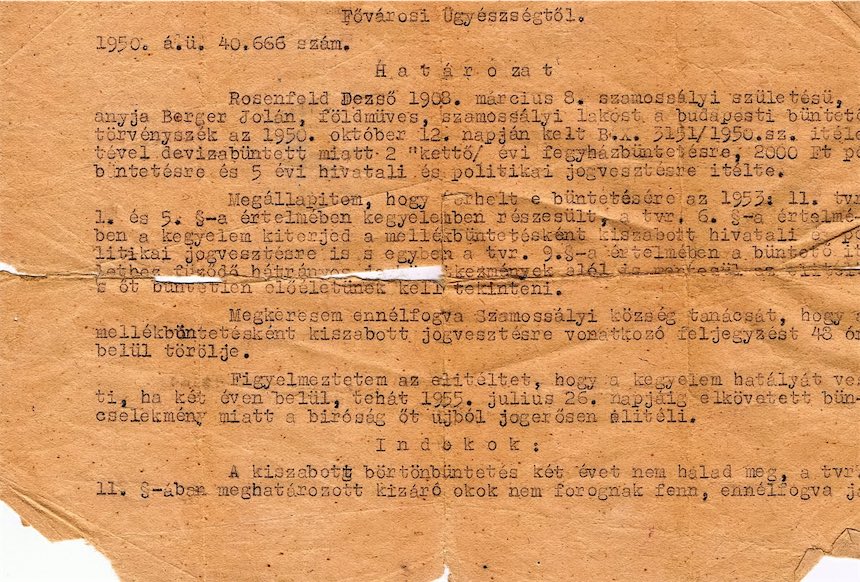
Two days later, two men in leather coats came to our house and asked for my father. They were ÁVOS — secret police officers — and they took my father away. Unknown to us, the package had been searched by the government before being delivered. He was sentenced to two years hard labor in prison, five years probation, and a monetary fine. Under the Communist regime, possession of US currency was a serious political crime.
My father's court decree of punishment, 1950.
From 1950 to 1953, my father was in jail. My mother had to do the work of both of them for the two years he was gone. She took me to visit him in prison several times, but it was a long, arduous trip — we had to travel many miles by horse-drawn cart and steam railroads.
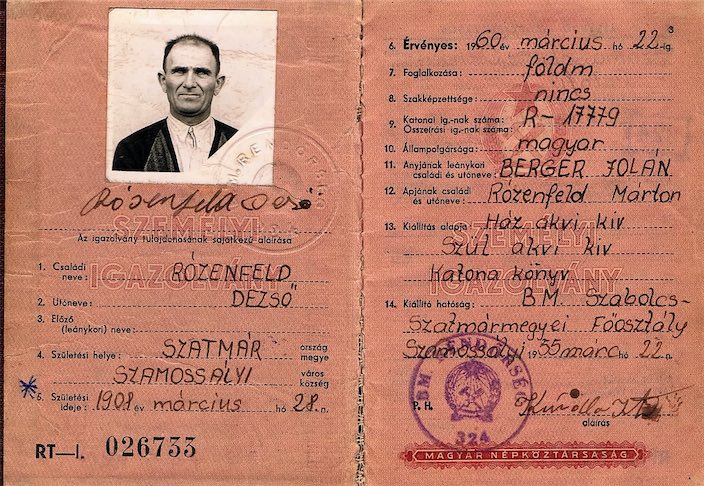
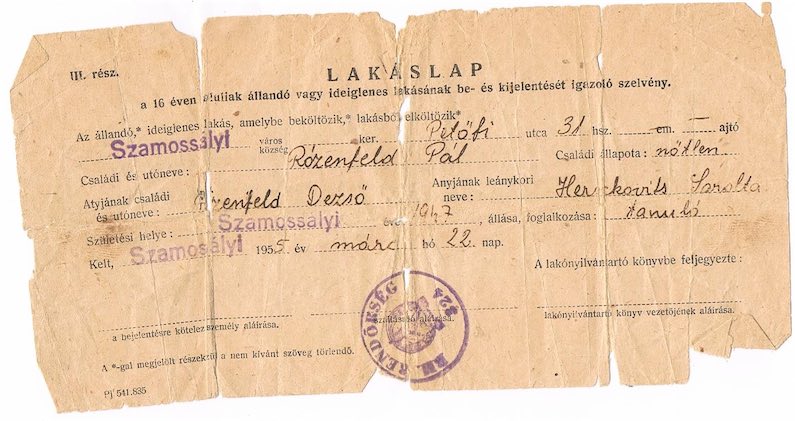
Father's identification paper, March 1955. The Communists were big on bureaucracy and paperwork.
Anti-semitism in Hungary was always present. Under pressure from the government, my parents considered changing our name to a Hungarian name; the name they chose was "Rudas." The government was actively pushing Jews to change their names. Our friend Gross Miklos became Gati Miklos; our friend Schwartz Miklos became Sipos Miklos.
Chapter VIII
The Great Escape
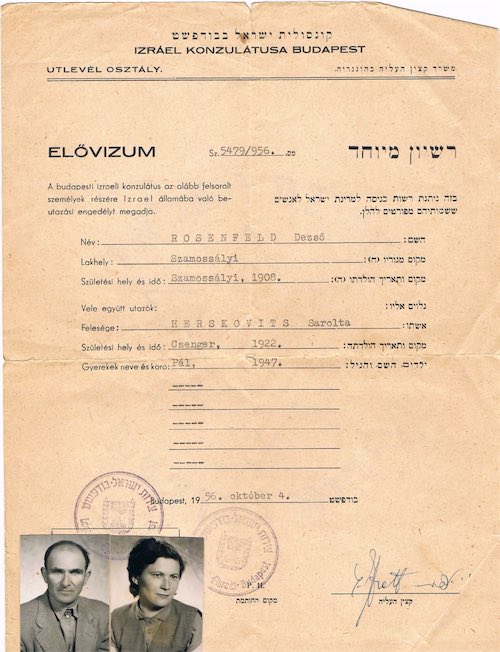
My aunt, who was living in Israel, finally convinced my parents to emigrate. We applied for a visa in October 1956. On October 4, 1956, the visa to Israel had been granted. But historical events were about to change our plans.
The visa to Israel, granted October 4, 1956 — just weeks before the revolution changed everything. The document lists Rosenfeld Dezső, his wife Herskovits Sarolta, and their son Pál, born 1947.
On October 23, 1956, Hungarian university students demonstrated against the government. Gunfire erupted and many were killed. Full-scale battles were fought between freedom fighters and the Russian military. At first the Hungarians seemed to force the Russians out, but the Russians returned.
As the revolt ended, the residents of Szamossályi blamed the Jews. I was beaten up in school and called a "Búdos Zsidó" — Stinking Jew. That same night, a torchlight demonstration was held in front of our house. My father made up his mind: we must leave. In two days, we were on our way.
✦ ✦ ✦
My father tried to sell off as much of our property as possible in the short time we had. What he couldn't sell, we simply left behind. A Jewish friend in a nearby town had dealings with smugglers, and my father asked him to find someone who could get us out of Hungary to Austria.
With forged travel documents, we traveled to Budapest — a city heavily damaged from the fighting, with Russian tanks and soldiers with submachine guns everywhere. We stayed at Adel Néni's (Aunt Adele's) house; she was a close friend of the family.
Adel Néni (Aunt Adele) — the family friend in Budapest who sheltered us.
After a few days, the smugglers contacted us. We took the train to a border town, arrived at a safe house, and at nightfall — carrying all of our possessions, including the photos you see on this page — we left with the two men and began walking toward the Austrian border.
The journey was supposed to take two hours. The night was cold and clear. Thousands of Hungarians were escaping to Austria in the aftermath of the failed revolt. To stop the escapes, border police lit the skies with bright flares that illuminated the ground below. Four hours into our journey, we realized something was wrong. I was cold and thirsty; the only beverage available was a bottle of homemade slivovitz brandy my father had brought along.
We were lost.
After another hour of wandering through farm fields and woods, we came to a paved roadway with a modern-looking building nearby. The smugglers decided we must already be in Austria. To be sure, one of them went to the building to ask. A woman in a bathrobe answered — she blew a whistle. We were trapped: the building was a border police outpost.
The building lit up like a Christmas tree. The smuggler was detained. Searchlights were aimed at us and we were ordered to surrender. We decided to run. The sky lit up like the Fourth of July — gunfire erupted and tracer bullets came toward us. Lucky for us, their aim was bad. In the chaos, the captured smuggler managed to escape and eventually caught up with us.
✦ ✦ ✦
A Stranger in the Night
Now for my "Twilight Zone" experience. We were exhausted and still lost, sitting on our suitcases in an open muddy farm field somewhere in western Hungary. It was probably 3 or 4 in the morning.
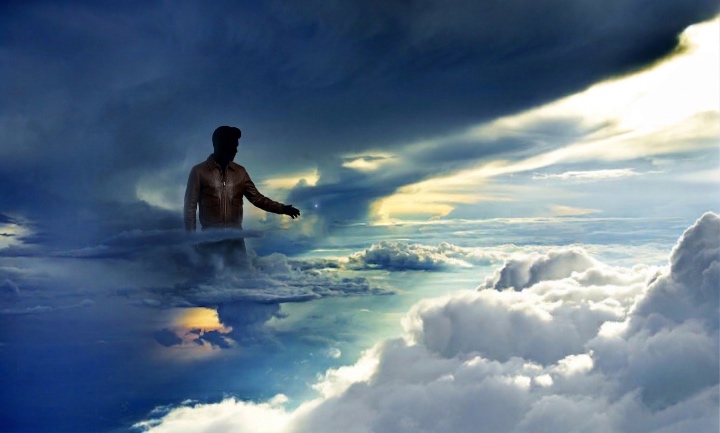
A mysterious young man led us to freedom.
A young man in a leather jacket approached us out of the pitch-black night. He asked what we were doing. We told him our story. He said he was heading to Austria to visit his sister and offered to guide us — but pointed out it was getting close to dawn and would be dangerous to cross at that hour. He asked us to follow him to a nearby town where friends would let us wait for nightfall.
We followed him, rested during the day, and at nightfall we left again. The crossing into Austria was uneventful. After about an hour of walking, we came to a ditch in the ground. We crossed it, and the young man told us we were now safe in Austria.
Chapter IX
Coming to America
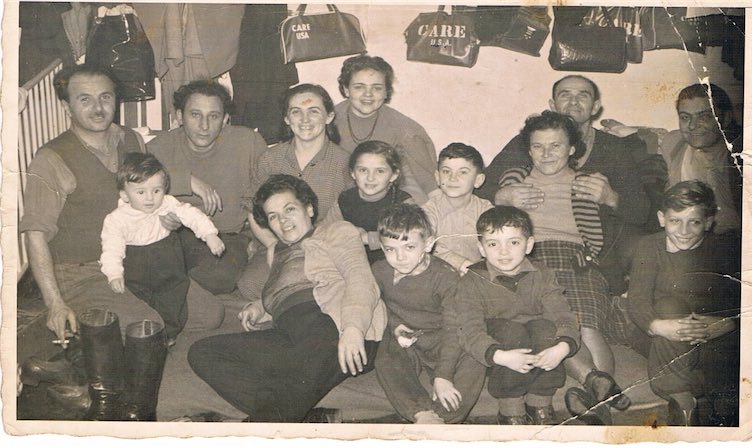
We spent the first month in Vienna in a building that was a public school; we slept on mattresses on the floor in tight quarters. Vienna was a new world for me — I saw and ate my first banana and orange, and saw my first black person.
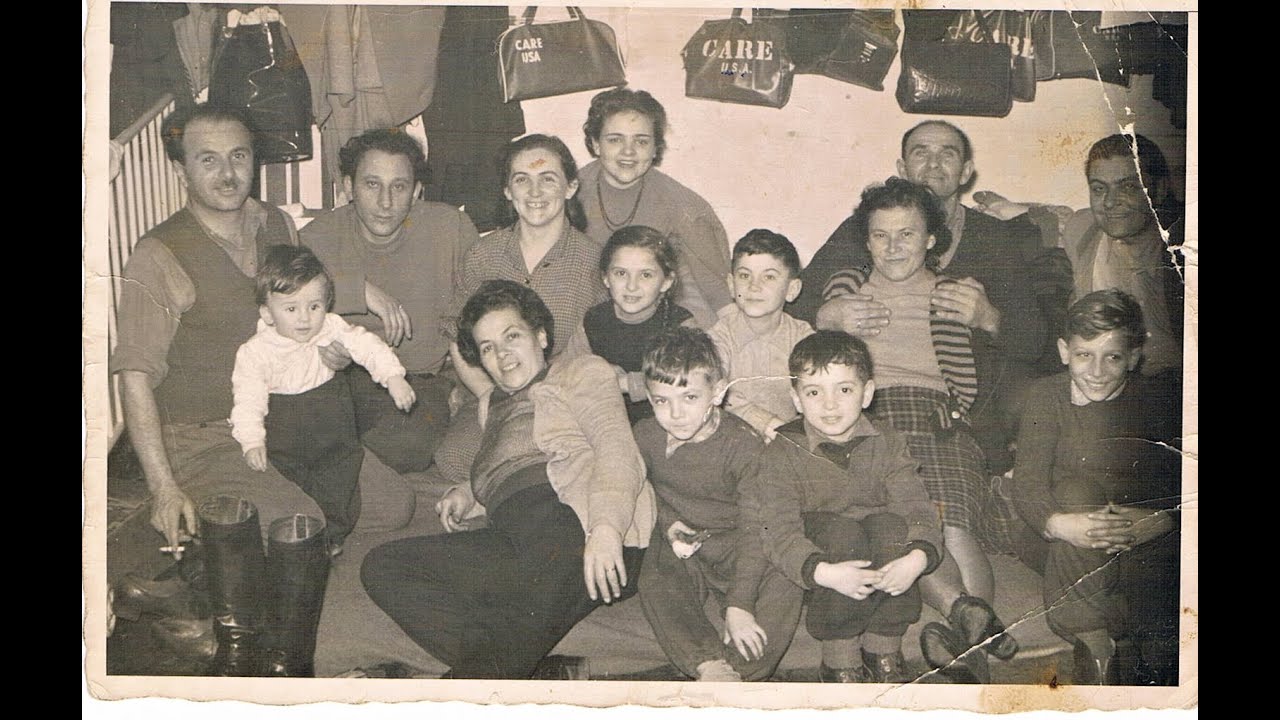
Vienna, Austria, January 1957. Note the gym bags on the wall — they say "CARE USA." That organization was really helpful to the refugees.
The next eight months were spent in Kronenburg, a town on the Danube. Ironically, the camp we were in had been a Nazi military base only 12 years before. Signs warning of danger and land mines were posted throughout the perimeter.
By the Danube River, near the Kronenburg refugee camp in Austria, 1957.
After spending nine months in Austrian displaced persons camps being vetted by the US State Department, we were finally allowed to leave for New York. We arrived on September 18, 1957.
Our family met us at the St. George Hotel in Brooklyn. My great-uncle Sam Herskovits was our sponsor. He found us an apartment in the Brighton Beach section of Brooklyn, found jobs for my parents, I started school — our new life in a free America had begun.
To quote my mother's favorite saying, which she pronounced with a thick Hungarian accent: "G-d Bless America."
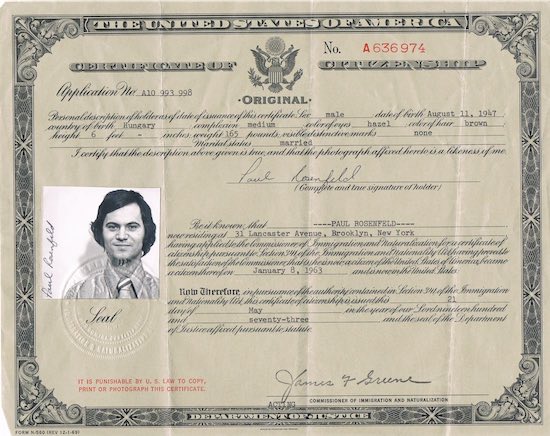
Paul Rosenfeld's Certificate of Citizenship, January 1963. My parents became proud Americans and applied for citizenship at their first opportunity.
Chapter X
Going Back
My parents went back to Hungary two or three times to visit old friends who had stayed behind.
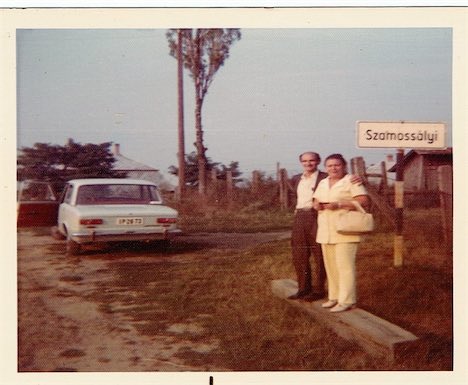
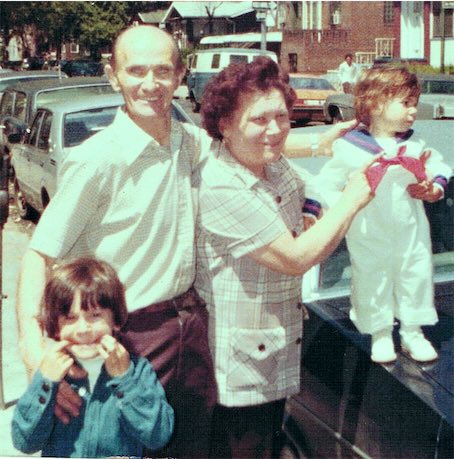
My parents' first trip back to Szamossályi, 1967.
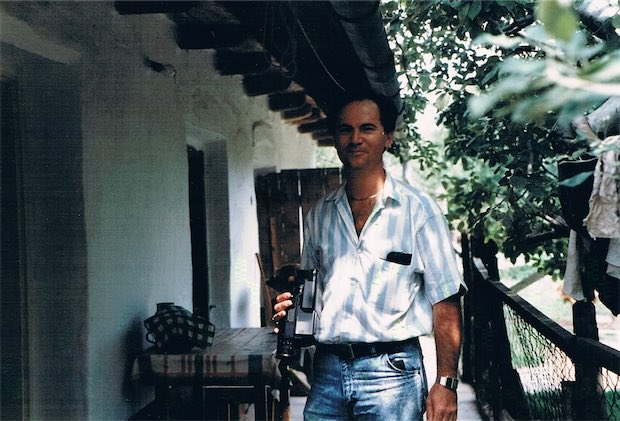
In 1988, Lenni and I visited Hungary — it was still under Communist government. We did not go back again for many years. People asked why I didn't return, since Budapest has become a popular tourist destination. I didn't want to return because of all the unpleasant memories.
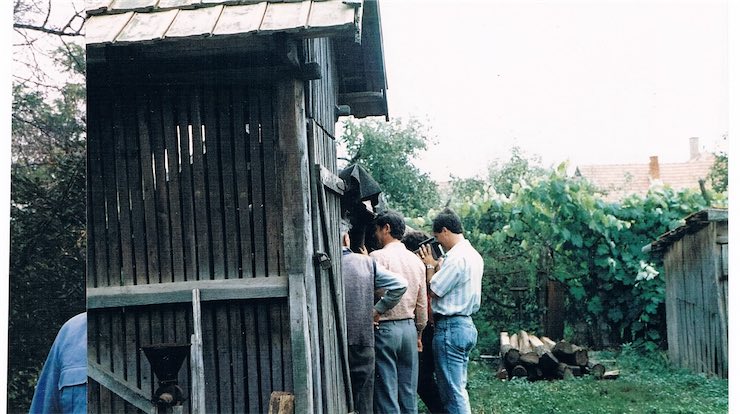
Visiting the old family property, 1988. The new resident was an elderly woman who converted our dairy barn into a home.
The corn drying hut built by my father; our "modern" outhouse is on the right.
✦ ✦ ✦
Szamossályi Today
When I left in 1956, electricity had just come to town for the first time — a single hanging light fixture in our one-room home with a wall switch, that only worked a few hours at night. Even the installation of electrical service involved anti-semitism: the townspeople decided to remove the metal fencing around the Jewish cemetery to use as poles for the power lines.
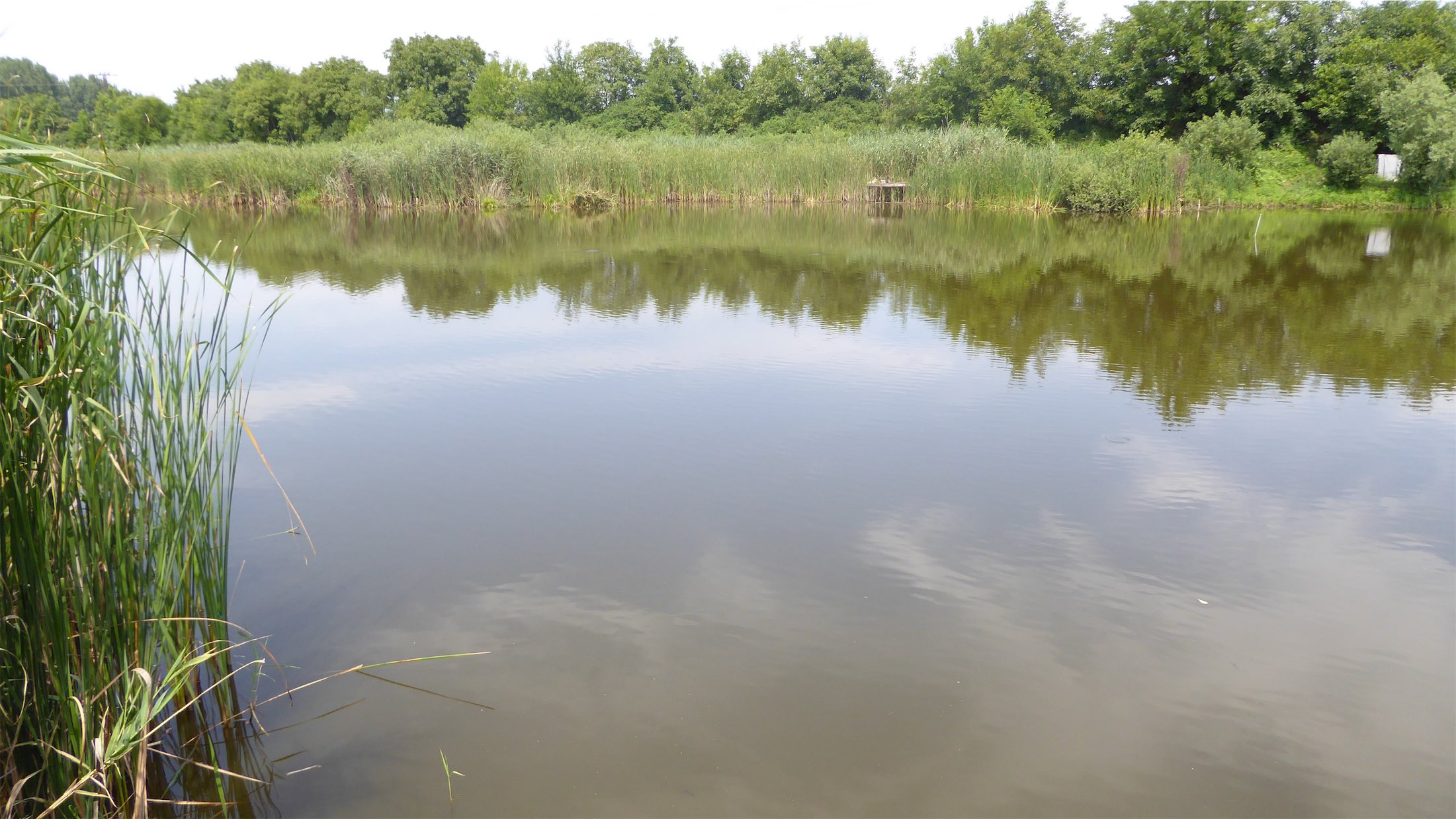
The Holt Szamos (Dead Szamos). The river that once flowed in our back yard was dammed in the early 20th century and became a bow-shaped lake. As a child, I fished and ice-skated here.
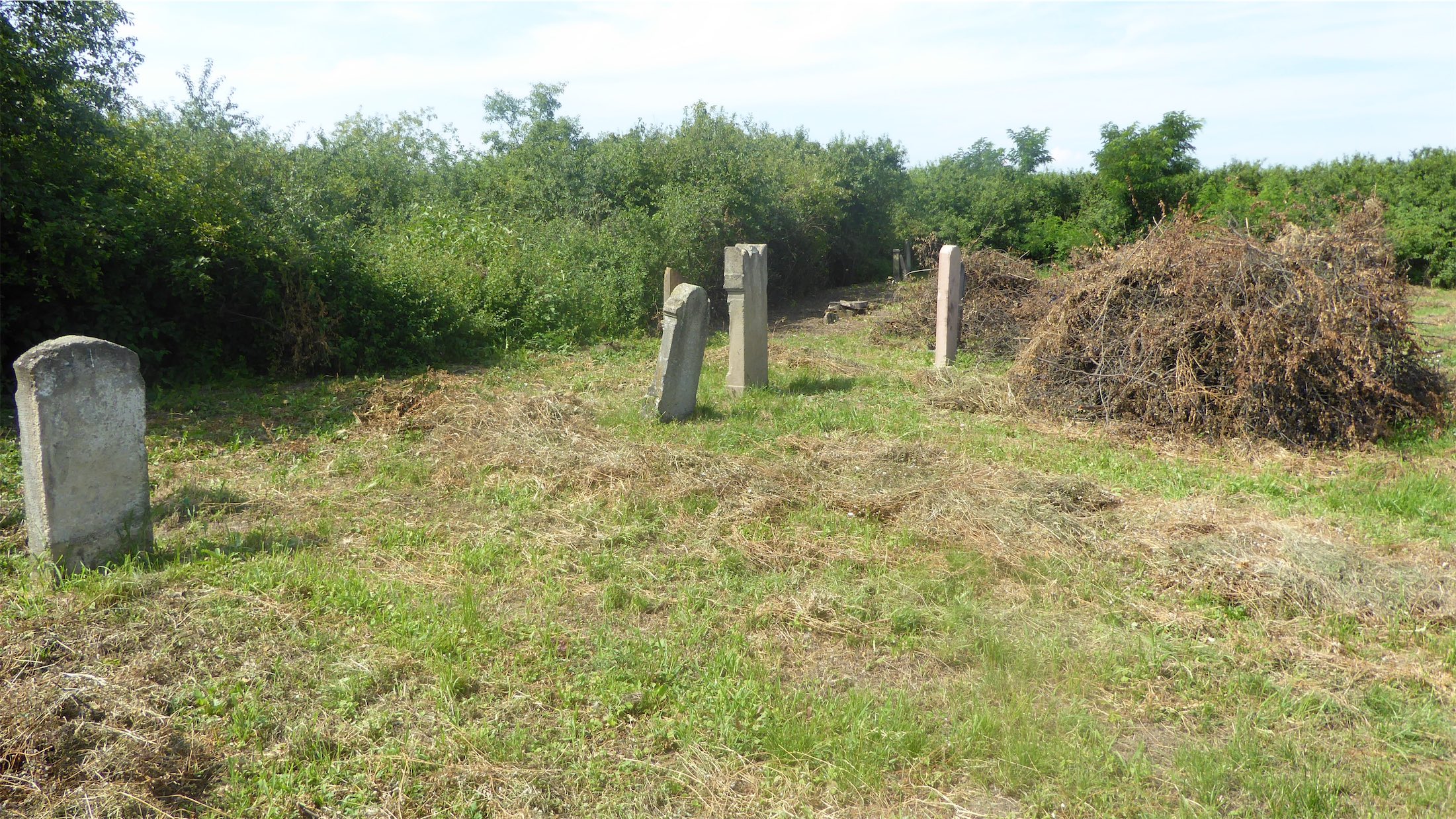
The Jewish Cemetery in Szamossályi. It looks better than on previous visits — someone paid to clear the overgrowth. Note the absence of fencing, stolen decades ago.
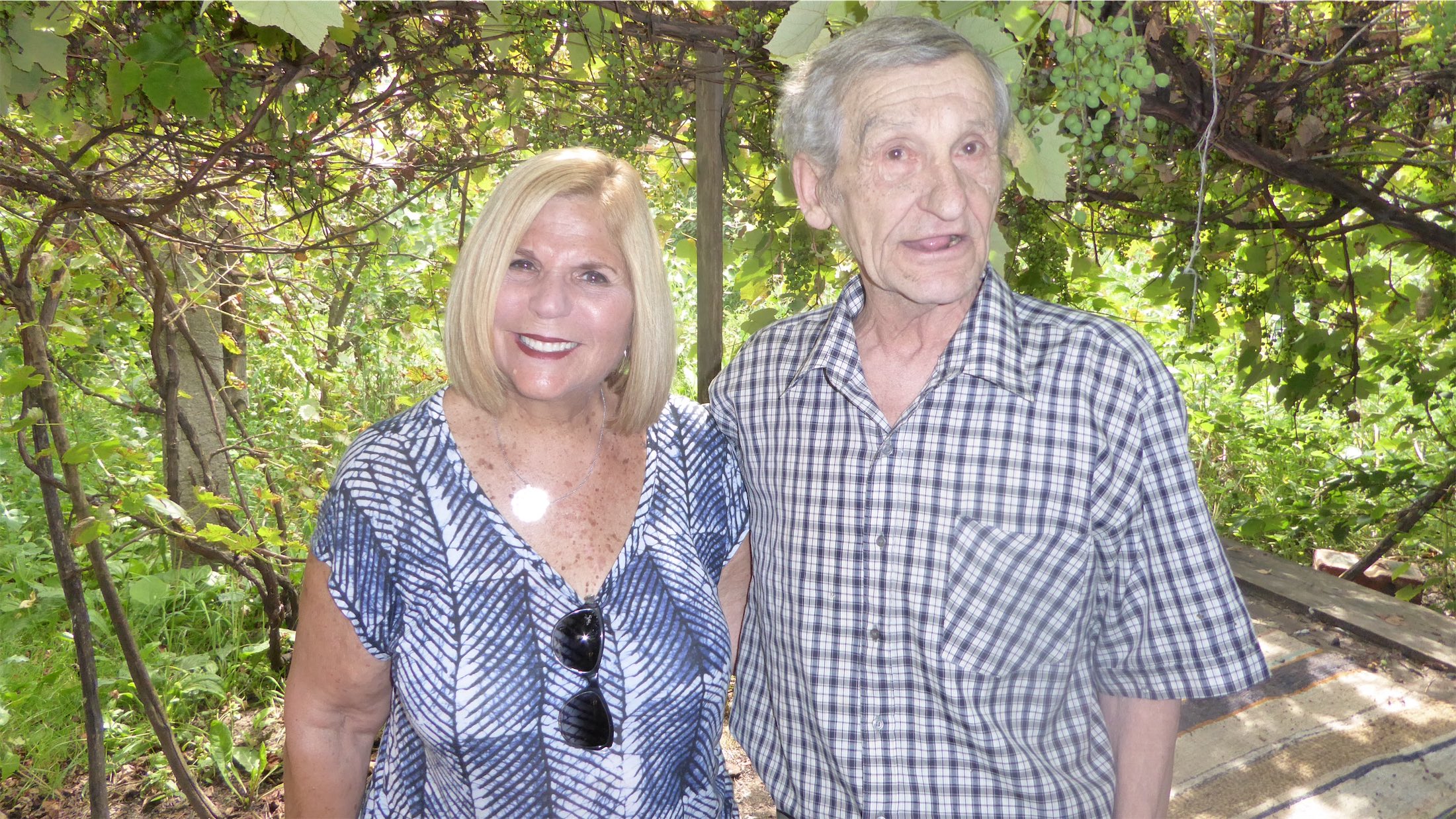
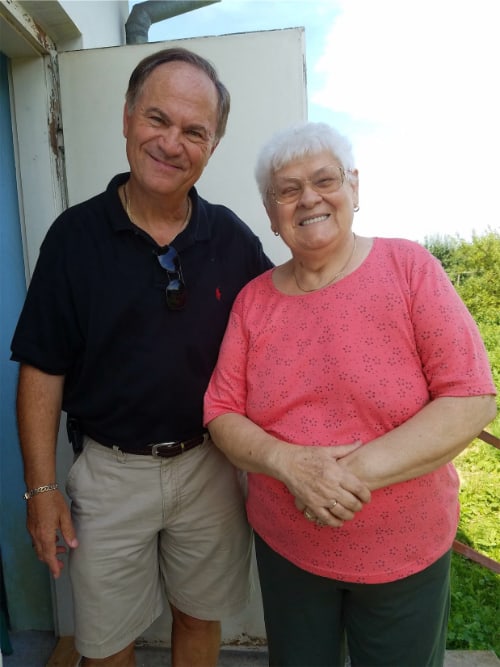
My wife Lenni and my childhood friend Aladar (Bajnai Gábor). He and I were both born in 1947. He was thrilled to see us. The townspeople greeted us as celebrities — they all prepared homemade cakes and pastries. Nine months after this photo was taken, Aladar passed away.
✦ ✦ ✦
"You Must See Mimi!"
The last time I saw Mimi Bajnai was in the fall of 1956. Her family lived across the street from us. She was about 16 then — a beautiful young teenage girl. Until I was told she wanted to see me, I hadn't thought of her in almost 60 years, but I did remember her.
Mimi Bajnai, my neighbor who I had not seen for 60 years.
She was waiting for us with delicious homemade pastries. She began to tell her story: in December 1956, as my parents prepared to leave Szamossályi for the last time, they went to say goodbye to the Bajnai families. The night they visited, Mimi wasn't there, and she never got to say goodbye. This had weighed on her mind for all those years. She wanted to tell me the story and have closure. Mimi was later moved to a home for the elderly; she passed away in the winter of 2022.
✦ ✦ ✦
An Apology
As we explored the property that once held my home, Aladar turned to me and said:
"Pali, we are so sorry for the way you were treated and for the things that happened to your family. You know we were not like that. We were like brothers, and my family loved your family."
I truly believed him, and knew this all along. I would never have come back to Szamossályi had I not believed him.
Chapter XI
Remembrance
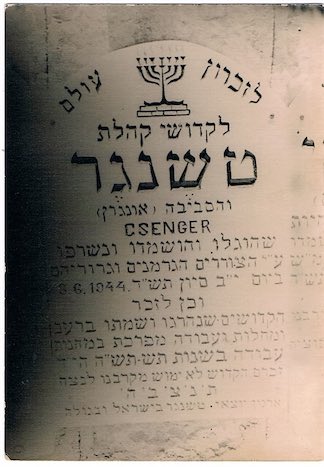
A monument to the lost Jewish community of Csenger, located in Israel.
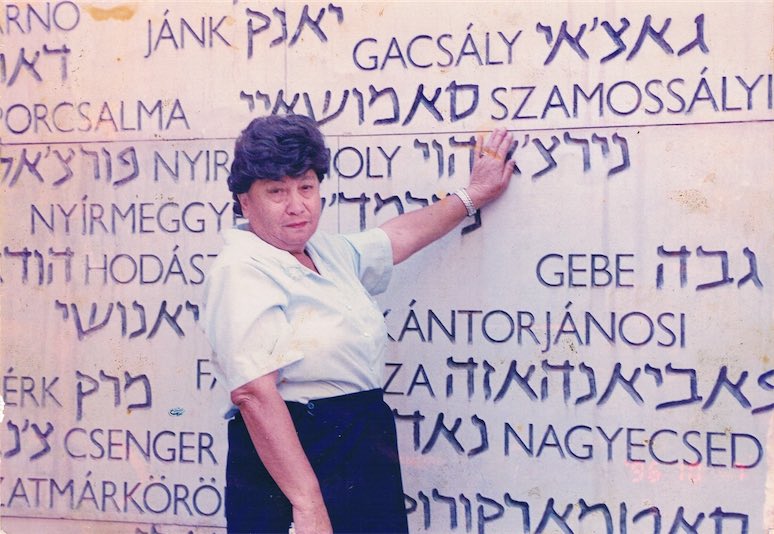
My late aunt pointing to the Szamossályi inscription on a Holocaust memorial in Israel.
The Final Tally
Other than my parents, my mother's sister Joli, and my father's sister Serena (who moved to the United States in the 1920s), all other immediate family members were exterminated in the Holocaust.
Most of you have extended families. You lived your life having grandparents, and in some cases even great-grandparents. They may be deceased, but you have your memories of them and can visit the cemeteries where they are interred. My situation is different. I never had grandparents — they were exterminated in 1944.
Dedicated to the memory of my parents, Dave (Dezső) Rosenfeld and Sara (Sarolta) Rosenfeld, and the six million who perished.
G-d Bless America
— Sara (Sarolta) Rosenfeld
✦ ✦ ✦
The Presentation
This site was adapted from a talk Paul Rosenfeld has delivered to audiences across the country—a firsthand account of his family’s survival, displacement, and new beginning. The original presentation, in its entirety, can be viewed below.